
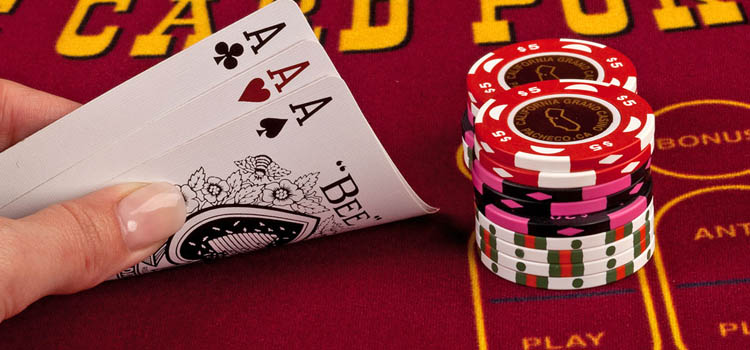
One of them is the classic strategy used by most 3-card poker players and the other, the so-called "Flashing Dealer" or intermittent dealer, is a little more controversial in its design and requires certain factors to be in play before being used. Let's take a closer look at both strategies.
The basic strategy in 3-card poker
The basic strategy that has been adapted for 3-card poker is quite simple. In general terms it dictates that you always have to double the hand you have, if you have less than Q, 6,4 Debers continue betting.
In order to decide quickly whether or not you should play, as a general rule, if your first card is equal to or stronger than a 6 you must continue regardless of the value of the third and last card. The reason is because you only look at your first two cards is because the hands are scored and ranked on the highest card and then the second highest if there is a tie. It is very rare to have to go to a third card to tie and decide a winner.
The reasoning behind this strategy is based on math, i.e. the amount you can expect to lose by folding. Q, 6 4 is the lowest hand to play simply because if you raise at nothing lower you can expect to lose more than 1 unit per fold. If you raise at Q, 6.4, you can expect to lose less than 1 unit. The most important thing is to have fun while playing 3-Card Poker.
The Intermittent Distributor Strategy
A little less conventional in 3-card poker is the strategy called "Flashing Dealer" or the intermittence of the dealer. Literally it is a strategy that is based on whether or not you are getting a view of one of the dealer's cards.
However, it is not uncommon to find a dealer of 3 poker cards who exposes one of his poker cards, due to the height and position of the dealer. Right-handed dealers tend to take the cards from the side that has the most potential to expose the lower card, just as they are placed on the table. The best seating position for this type of strategy is the first position to the left of the dealer, better known as "First Base.
Now all that's left to know is how all that helps, right? If you can clearly determine the dealer's range of cards, then there is a list of games you can use depending on which of the cards dealt by the dealer or croupier you have been able to get a glimpse of. The following points you will find below describe the appropriate action to take depending on the card exposed.
- Cards with a value from 2 to one Jack = always raise
- Queen= Only lift with a Q, 9,2
- King= Only come up with a K, 9, 2
- As= Only lift with A, 9, 2
If all you could see is that the dealer has a "face card" (black cards J, Q and K), then you should only consider going up if he has a Q, J, 5 or higher. If this one is able to say that the distributor does not have a face card then you must increase, independently of if these or not sure if they have an Ace, because statistically speaking, most of the times they do not have it.
Popular Posts

3 TIPS ON HOW TO CHOOSE THE BEST ONLINE CASINO?
17 September

Basic strategies
4 July

3-card poker
10 July

Tournaments Strategies
1 August